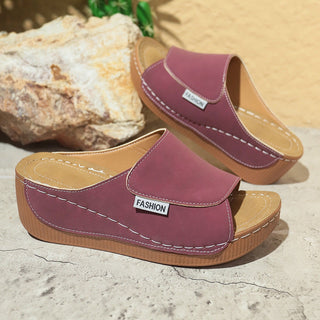
Office shoes for women: getting through the day without pain
An office shoe is something you wear for eight to ten hours straight, usually across carpet, tile and twenty minutes of pavement. Most guides talk to you about style. The real subject is getting through the day without ending up barefoot under your desk at 4pm.
The useful heel height sits between 3 and 5 cm
Below 3 cm you're flat: fine if the sole is cushioned, tiring if it isn't, because the heel takes every step with nothing to absorb it. Above 6 cm your weight tips onto the forefoot and pressure on the metatarsals climbs fast. Between the two, you get the leg line without paying for it.
If you love high heels, save them for seated days — meetings, presentations, business lunches — and keep a flat pair in your drawer. That isn't giving up. It's what every woman who has worn heels for twenty years already does.
An ankle strap is not decoration
This is probably the most useful line in this article. A classic court shoe stays on through pressure on the forefoot alone: you clench your toes without noticing to stop it slipping off. An ankle strap moves that job to where it belongs. The result is that you walk normally and don't finish the day with cramp.
Same logic for slingbacks: the back strap does the work and the front stays open. That's also what makes them bearable in an open-plan office in summer, when a closed court shoe turns into a sauna.
Court shoes that stay on


An office flat is not a supermarket ballet pump
A ballet flat with a cardboard sole does more damage than a 5 cm heel. What you're looking for: a round or gently almond toe (a pointed toe compresses the big toe), a sole with some actual thickness, and a lining that doesn't rub at the heel.
The round toe has a quiet advantage too: it leaves room late in the day, once the foot has swollen. Feet routinely gain half a size between 8am and 6pm. That's not a myth.
Flats you can wear all day


The commuting pair, and why to own one
If you walk more than a kilometre or stand on public transport, get a proper walking pair and change at the office. A soft sneaker with a cushioned sole does the commute, the court shoe does the day. It's less appealing than the idea of one shoe that does everything, but it saves your feet and your dress shoes, which mostly wear out outdoors.
For the commute


How to get the size right
- Measure at the end of the day, never in the morning.
- Measure both feet: half a size of difference is normal, and you fit the larger one.
- Leave roughly 5 mm between your longest toe and the end of the shoe.
- If you wear tights at work, try them on with tights. It counts.
- A shoe does not "break in" across the width if the construction is rigid. Soft leather gives a little, that's all.
Three outfits that work
Client meeting. Straight trousers, plain blouse, 4 cm strapped court shoe. Nothing sticks out, nothing shouts.
Ordinary office day. Wide flowing trousers, top tucked in at the front, round-toe ballet flat. Comfortable without looking careless.
Summer in an open-plan office. Slingback or dressy sandal, light trousers, short jacket left on the back of the chair for the air conditioning.
The rest of the outfit


The rest of the selection sits in the office looks collection, and all our shoes are gathered here.
Read next
- Flats or heels: choosing by occasion
- Heel pain in the morning: what the shoe changes
- Wide feet: how to pick a pair that fits
Unsure about a size or a fabric before ordering? Email support@voltelan.com and we answer within 24 working hours. Returns are possible within 30 days if the piece doesn't work out.
Shop the Best Sellers edit
-
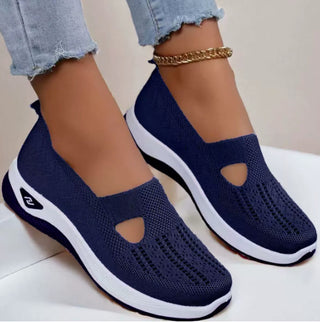 SNEEK Comfort Sneakers for Women — Memory Foam Insole, Breathable Knit
37,99 €
SNEEK Comfort Sneakers for Women — Memory Foam Insole, Breathable Knit
37,99 €
-
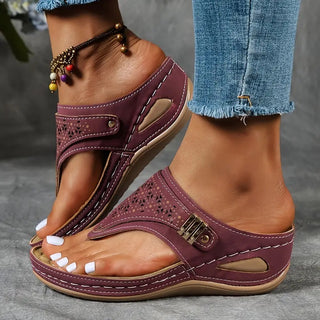 Élise Comfort Sandals — Contoured Footbed, Wide Straps
34,99 €
Élise Comfort Sandals — Contoured Footbed, Wide Straps
34,99 €
-
 Hivery Winter Shoes — Warm Lining, Cushioned Sole
34,90 €
Hivery Winter Shoes — Warm Lining, Cushioned Sole
34,90 €
-
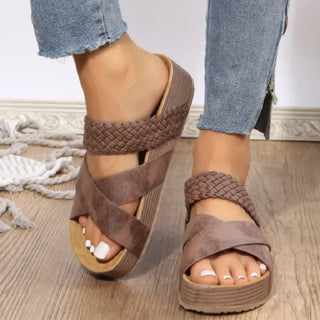 Women's Woven Casual Sandals - Summer Comfort
31,99 €
Women's Woven Casual Sandals - Summer Comfort
31,99 €