

Hot flashes: the fabrics and cuts that actually hold up all day
Share
Here is the detail the usual advice never mentions: the problem is not being hot, it is the speed. A flash rises in seconds, lasts two or three minutes, and leaves behind a film of sweat that goes cold all at once. So the garment has to handle two opposite jobs back to back: wick very fast, then not sit cold and stuck to the skin.
That double constraint knocks out half of what gets written on the subject. "Wear something light" is not enough: light synthetic is a disaster, thick linen is excellent.
An honest ranking of fabrics
What works
Linen. Nothing beats it. The fibre is hollow, it takes up to 20% of its weight in moisture without feeling wet, and the loose weave lets air through. Its flaw, creasing, is a matter of habit far more than of elegance. A loose linen shirt (23,99 €) or a pair of linen trousers (23,99 €) are the two best-value things in a wardrobe on this criterion.
Cotton, as long as the weave is open. A fine poplin and a thick jersey have nothing in common despite the identical label. Cotton absorbs well but dries slowly, and that is its limit in the second phase, the cold one.
Cotton-linen blends. The best practical compromise: linen's breathability with less creasing. A flowing cotton-linen midi dress (39,90 €) covers just about everything a summer day outdoors throws at you.
Bamboo and modal. Technically man-made fibres, but cellulose-based, and far more breathable than polyester. Modal feels cool to the touch and drapes well. A long bamboo cardigan (39,90 €) solves the layer-you-take-off problem I come back to below.
What does not
Polyester. It absorbs nothing. Sweat stays on the skin, the fabric clings, and odour sets in faster than with any natural fibre. A garment being thin changes none of that.
Viscose, whatever its reputation. It feels cool to the hand, which fools people in the shop, but it soaks up water and takes an age to dry. It also shows visibly across the back and under the arms. Probably the most overrated fabric on the rail.
Any synthetic lining. A linen dress lined in polyester loses most of the point. Check the lining composition, not just the main fabric.
The cut counts as much as the fabric
Fabric only breathes if there is air between it and the skin. Which gives a few simple principles:
- Loose, not shapeless. The volume belongs where heat gathers (back, waist, underarms) and the structure elsewhere. A flowy summer dress (29,90 €) works because it lifts away from the body without erasing the line.
- An elastic waist rather than a button. The waist is the first thing that becomes unbearable during a flash. Wide trousers with an elastic waist (29,99 €) fix that without looking like loungewear.
- Open sleeves. Bell sleeves, wide three-quarter sleeves, cut-in armholes: air moves. A long sleeve fitted at the wrist traps the heat of the whole arm.
- An open neckline. The neck and upper chest are the areas most involved. A V-neck or a wide neckline lets heat out without undressing.
The real subject: the layer you take off
This is the strategy that works best day to day, and it has an unglamorous name: layer so you can remove. A vest top or a fine natural-fibre top under an open shirt or a light cardigan lets you shed a layer in ten seconds, without a trip to the bathroom and without anyone noticing.
Which means you have to choose the under-layer as if it were going to be seen, because it will be. A fitted V-neck top (26,90 €) under a linen shirt is a complete outfit once the shirt comes off. An old sleep t-shirt is not.
Two pieces of received wisdom to bin
"Avoid black." True in full sun, false indoors. Black absorbs solar radiation, which matters at the seaside and not in an office. It also shows sweat marks far less than marl grey or pale blue, which is a genuine advantage in a meeting. The worst colour for visible sweat is mid grey.
"Sportswear is the comfortable option." Technical fabrics are engineered to wick during sustained effort, not to handle a sudden spike followed by a stop. Most of them are largely polyester. A linen shirt does the job better in ordinary life.
Where to start
If you are replacing three pieces and no more: linen or modal trousers with an elastic waist, a loose linen shirt, and a light cardigan that comes off. Between them those three cover most situations and combine with what you already own. The flowing, loose styles are gathered in elegant dresses and workwear looks, and the alternatives under €30 are in budget picks.
One last thing: redoing your wardrobe will not make the flashes go away. It makes the days they turn up considerably less miserable, and that is already a lot.
Shop the Best Sellers edit
-
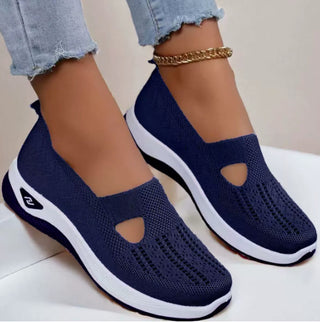 SNEEK Comfort Sneakers for Women — Memory Foam Insole, Breathable Knit
37,99 €
SNEEK Comfort Sneakers for Women — Memory Foam Insole, Breathable Knit
37,99 €
-
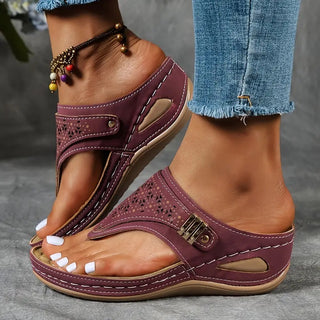 Élise Comfort Sandals — Contoured Footbed, Wide Straps
34,99 €
Élise Comfort Sandals — Contoured Footbed, Wide Straps
34,99 €
-
 Hivery Winter Shoes — Warm Lining, Cushioned Sole
34,90 €
Hivery Winter Shoes — Warm Lining, Cushioned Sole
34,90 €
-
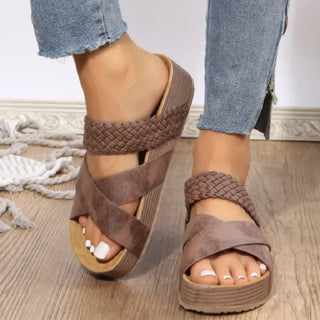 Women's Woven Casual Sandals - Summer Comfort
31,99 €
Women's Woven Casual Sandals - Summer Comfort
31,99 €

