

Wide feet: stop buying a size up
Share
The sentence always comes out the same way: "I'm a 38 but I buy a 39 because my feet are wide." That is a workaround, and it has a price. A wide foot needs volume, not length. Two different dimensions, and shoe size only controls the second one.
What actually happens when you go up a size
A shoe is built around a last. Go up a size and everything moves at once: the point where the sole bends shifts back by half a centimetre, the arch support no longer sits under your arch, the heel counter is suddenly too wide.
In practice the foot travels forward inside the shoe with every step. Toes hit the end, the heel lifts, and you compensate by gripping with your toes. Three classic symptoms follow: blisters at the back of the heel, blackened nails on both big toes, and an aching arch by evening that gets blamed on age when it is really the shoe.
First, work out where it pinches
"Wide feet" covers three different situations, and they do not have the same answer:
- Wide across the forefoot. It pinches at the toe joints, just behind the toes. The most common case, and it gets worse over the years.
- High instep. Width at the floor is normal, but the top of the foot is domed. The shoe presses across the instep, not at the sides. A Mary Jane or a lace fixes it. A closed court shoe never will.
- A localised deformity. A bunion sticks out at one precise point. That is no longer about general width but about one zone you must not compress, and there is a dedicated selection for it: see bunion shoes.
The test that settles it: stand barefoot on a sheet of paper, trace round the foot with the pencil held upright, then put the shoe's insole on top of the outline. If the line spills out at the sides, size is not the issue. No amount of extra length will ever accommodate width.
The five criteria that count
A round or square toe, never pointed
A pointed toe does not just narrow the tip. It stacks the toes on top of each other over the last two centimetres. A round toe leaves them flat. It is the easiest thing to judge from a product photo and the most reliable. The round-toe comfort ballerinas (29,90 €) are the textbook example: the shape respects the natural spread of the forefoot.
A soft upper
A material that relaxes takes the shape of the foot after a few wears. A rigid one imposes its own. On a closed shoe, that is the difference between a pair you adopt and a pair that lives in the cupboard. The flexible shoes with a cushioned sole (37,99 €) bet everything on that.
Something to adjust
Buckle, lace, hook-and-loop, elastic strap: anything that opens up the volume. A shoe with no adjustment offers one volume only, and that volume belongs to an average foot. The strappy comfort sandals (47,90 €) multiply the adjustment points, so you can open up exactly where it catches without loosening everything else.
A removable insole
Underrated detail: taking out the original insole gives back a few millimetres of height, and lets you slip in an orthotic if you wear one. On a high instep, those millimetres change everything.
No seam in the wrong place
Look at where the stitching runs on the photos. A seam crossing the big toe joint rubs at every flex. You will not feel it when you try the shoe on. It shows up two hours later.
What works, and what to give up on
You read everywhere that wide feet mean giving up on elegance. Not true, but there is a sorting job to do. These work well: multi-strap sandals, round-toe ballerinas, wide sneakers, mules with a broad vamp, wedges. These work badly whatever the brand: the pointed court shoe, the ballerina cut so low it stays on by side pressure alone, and the single thin-strap sandal that saws the forefoot in half.
For an evening where a heel really is expected, the sensible compromise is an ankle-strap style: the hold comes from the ankle rather than from squeezing the forefoot. The rest of the wide and soft selection sits in women's comfort shoes, and the models that come back most often in orders are in best-selling comfort shoes.
Ordering online without getting it wrong
Three precautions beat any size chart:
- Measure width, not just length. Tape measure round the forefoot at the joints, foot on the floor and bearing weight.
- Try them on carpet, in the evening, with the socks or tights you intend to wear. Sheer tights barely register. A walking sock is half a size of volume.
- Walk ten minutes in them before deciding. How they feel when you slip them on means nothing. Repeated flexing is what reveals the pressure points.
The whole thing fits in one line: your size is right, it is the shape that has to change.
Shop the Best Sellers edit
-
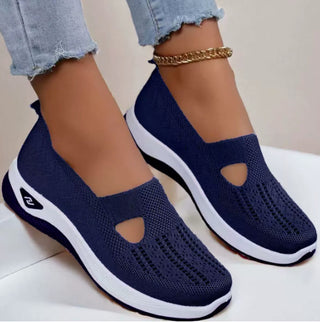 SNEEK Comfort Sneakers for Women — Memory Foam Insole, Breathable Knit
37,99 €
SNEEK Comfort Sneakers for Women — Memory Foam Insole, Breathable Knit
37,99 €
-
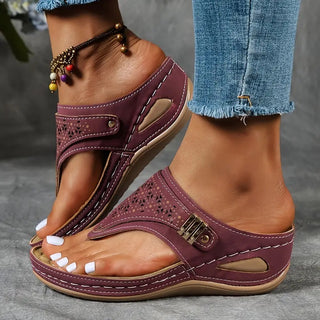 Élise Comfort Sandals — Contoured Footbed, Wide Straps
34,99 €
Élise Comfort Sandals — Contoured Footbed, Wide Straps
34,99 €
-
 Hivery Winter Shoes — Warm Lining, Cushioned Sole
34,90 €
Hivery Winter Shoes — Warm Lining, Cushioned Sole
34,90 €
-
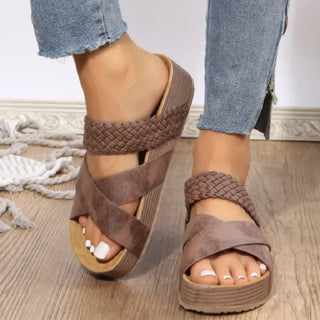 Women's Woven Casual Sandals - Summer Comfort
31,99 €
Women's Woven Casual Sandals - Summer Comfort
31,99 €

