

Swollen feet in summer: what actually changes when you pick shoes
Share
There is a moment in July when the shoes you put on that morning turn into a punishment. The foot has swollen, the strap is cutting in, and the evening ends in flip-flops because nothing else will go on. That is not bad luck and it is not the wrong size. It is a design problem.
Why feet swell, and by how much
Heat dilates the blood vessels and venous return gets sluggish. Add hours on your feet, a long drive or a flight, and the volume of the foot climbs through the day. In practice the swing between morning and 7 pm often reaches the equivalent of half a size.
That one figure explains most bad shoe purchases. A pair tried on at 10 am in an air-conditioned shop is tried on a foot you will not have at 6 pm. If the design has no give built in, it goes from snug to tight to painful.
Worth saying plainly: swelling in one foot only, or swelling that comes with pain, redness or heat, or that is still there when you wake up, has nothing to do with summer heat. That one goes to a doctor, not to a shoe shop.
The real mistake: buying a size up
It is the standard reflex and it is the worst one. A larger size is not just extra length. The heel cup gets wider, the flex point moves forward, and the arch of the sole no longer sits under your arch. The foot slides forward with every step, the toes hit the end, and you start clawing with your toes to hold the shoe on without noticing you are doing it. A good share of the pain people blame on swelling actually starts there.
The thinking should not be "bigger". It should be "more adjustable". Keep your size, and pick a shoe that agrees to change volume during the day.
Four details that make the difference
1. A fastening that adjusts, not one that decorates
A buckle with several holes, a hook-and-loop strap, a lace: anything that lets you loosen one notch at 5 pm. This comes first, ahead of the material, ahead of the sole. Watch out for fake buckles, the ones stitched in place for looks. There are plenty about, and they leave the shoe as rigid as a closed pump.
2. Elastic straps when fingers no longer cooperate
Arthritis in the hands, or simply no desire to bend down, turns an adjustable buckle into an obstacle. The serious alternative is elastic: the strap stretches to the volume of the foot and springs back, with nothing to set. The easy-on elastic strap comfort sandals (34,99 €) are built for exactly that, and they are the first pair I would suggest to anyone who dreads putting shoes back on.
3. A material that gives
Woven textile, soft leather or a braided strap follow the swelling. Stiff coated synthetic does not: it keeps its shape and the foot is what gets squashed. The in-store test takes three seconds. Fold the upper between thumb and forefinger. If it fights back like cardboard, walk away.
4. A sole that cushions without digging in
A swollen foot is more sensitive to pressure points. A padded sole spreads the load instead of concentrating it on the forefoot. The soft sandals with a massaging insole (39,90 €) work on exactly that, and throw in a non-slip grip that matters far more than you would think on wet tiles by a pool.
Wedges are the best summer idea going
Comfort and height get treated as opposites, wrongly. A stiletto does create a real problem: the whole load tips onto the forefoot, which is precisely the area that swells. A wedge keeps a continuous contact surface from heel to toe. You get three or four centimetres and the leg line, without the pressure point.
That is why the cushioned wedge sandals with adjustable straps (34,90 €) tick both boxes that matter here: an adjustable strap and spread load. The rest of the range sits in orthopedic sandals, and more broadly in women's comfort shoes.
Three habits that cost nothing
- Try shoes on in the evening. Never in the morning. It is the simplest rule and the most ignored. If you order online, try the parcel on at night, not when the courier hands it over.
- Rotate two pairs. Two different pairs worn alternately load the foot differently. One pair worn every day creates the same friction point, in the same spot, forever.
- Put your legs up for ten minutes. Feet above heart level when you get home. That is not a magazine tip, it is plumbing: venous return finally goes the right way.
If money is tight
None of this needs an expensive pair. An adjustable strap, a soft material and a flat or wedge heel exist at every price. Part of the comfort range stays under €30, gathered in budget picks. The real waste is not spending €35 on a pair. It is spending €80 on one you stop wearing after three outings because it bites at 6 pm.
If you keep one thing from all this: keep your size, change the fastening.
Shop the Best Sellers edit
-
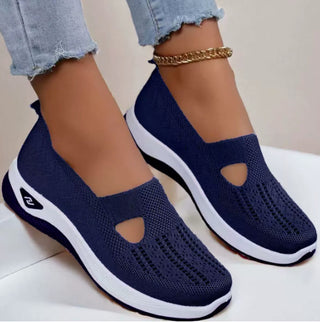 SNEEK Comfort Sneakers for Women — Memory Foam Insole, Breathable Knit
37,99 €
SNEEK Comfort Sneakers for Women — Memory Foam Insole, Breathable Knit
37,99 €
-
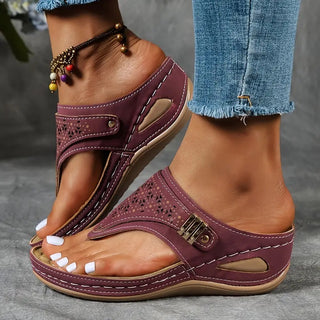 Élise Comfort Sandals — Contoured Footbed, Wide Straps
34,99 €
Élise Comfort Sandals — Contoured Footbed, Wide Straps
34,99 €
-
 Hivery Winter Shoes — Warm Lining, Cushioned Sole
34,90 €
Hivery Winter Shoes — Warm Lining, Cushioned Sole
34,90 €
-
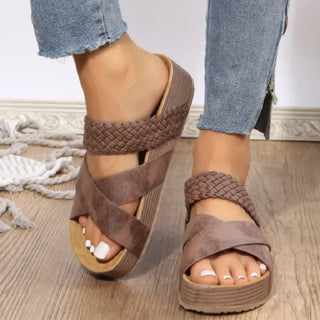 Women's Woven Casual Sandals - Summer Comfort
31,99 €
Women's Woven Casual Sandals - Summer Comfort
31,99 €

