Understanding textile materials: Which fabric for which use
The composition label sewn into the seam is the one part of a garment that never lies. It runs to three lines and it predicts almost everything: how the fabric will hang, whether it will itch by the end of the day, whether it will survive twenty washes or three.
Natural fibres
Cotton. It absorbs up to a quarter of its own weight in moisture before feeling wet, which is why it sits so well straight against skin. Its weakness is shrinkage: untreated cotton loses 3 to 5 % in the first wash, mostly in length. That's why a new t-shirt gets shorter before it gets narrower. Wash at 30°, dry flat, and it will last years.
Linen. Two to three times stronger than cotton, and the coolest fibre there is, because its hollow structure lets air move. It creases, and you have to make peace with that once and for all: it's mechanical, the fibre is stiff and breaks where it folds. Linen that doesn't crease has something else in it. It softens with every wash — a linen garment is better after three years than on day one.
Silk. Temperature-regulating, light, it slides over skin without catching. But it hates three things: direct sun, which yellows the fibres, sweat, whose salts attack the protein, and deodorant. Silk worn against skin gets washed after every wear, in cold water, without spinning.
Wool and merino. Wool still warms when wet, which no synthetic does nearly as well. Merino, finer, doesn't itch and holds very little odour: it's the only top you can wear three days running while travelling without thinking about it. Cold wash, wool cycle, and never a tumble dryer, which felts it permanently.
Man-made and synthetic fibres
Viscose. Made from wood cellulose, it imitates the drape of silk for a fraction of the price, and it's the fabric behind most fluid dresses. Its flaw isn't widely known: it loses up to half its strength when wet. A viscose dress spun at 1200 rpm comes out misshapen, and it doesn't come back. Short wash, minimum spin, dry on a hanger.
Polyester. It doesn't shrink, doesn't crease, dries fast, costs little. In exchange it doesn't breathe and it holds odour, because bacteria cling to a fibre that absorbs no moisture. Polyester can come out of the machine still smelling of something. It belongs in a lining, a rain jacket or an occasion dress worn for four hours. Much less in a summer t-shirt.
Elastane. Rarely alone, always as reinforcement. Between 2 and 5 % it adds comfort and stops knees bagging. Past 8 % the garment becomes shapewear. Worth knowing: it slackens with heat. The tumble dryer is what kills stretch jeans, not the number of washes.
Reading a blend without being fooled
Percentages are listed in descending order, and the first figure dictates how the garment behaves. "70 % cotton, 30 % polyester" behaves like a cotton that creases a little less. "70 % polyester, 30 % cotton" is a polyester with a pleasant hand, and it will sweat like a polyester.
Two blends keep their promises. Cotton-linen, which holds linen's coolness while creasing less, ideal for summer. Viscose-linen, which gives drape to a naturally stiff fabric. A third deserves suspicion: a list of four fibres or more usually signals a fabric designed to hit a price, not a use.
Which fabric for which use
For a hot day, linen or cotton-linen in a loose cut: it's the air moving between fabric and skin that cools you, not the fibre on its own. A viscose fluid summer dress does the same job as long as it doesn't cling.
For the office, viscose or a cotton-modal blend hangs well and survives a day sitting down without creasing behind the knees. For travel, merino and technical polyester split the bag: one for what touches skin, the other for what protects. For an evening, silk and viscose satin catch the light, but plan for the lining — those fabrics cling the moment it warms up.
See our blouses · See our bohemian dresses
The thirty-second test in a shop
Crush a corner of the fabric in your fist, hold five seconds, let go. If it stays marked, it will crease on you all day. Then pull gently on the side seam: if the fabric opens and shows the thread, the seam will give. Finally, hold the fabric up to the light. A very open weave means a garment you can see through and a fabric that will ladder at the first snag.
Our models that answer this need


Shop the Best Sellers edit
-
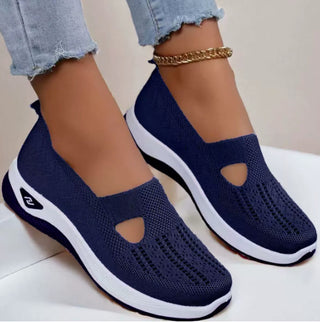 SNEEK Comfort Sneakers for Women — Memory Foam Insole, Breathable Knit
37,99 €
SNEEK Comfort Sneakers for Women — Memory Foam Insole, Breathable Knit
37,99 €
-
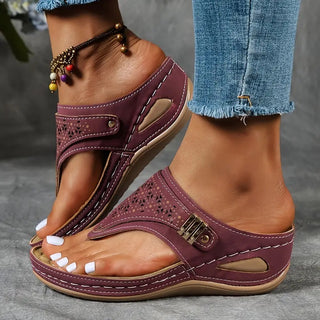 Élise Comfort Sandals — Contoured Footbed, Wide Straps
34,99 €
Élise Comfort Sandals — Contoured Footbed, Wide Straps
34,99 €
-
 Hivery Winter Shoes — Warm Lining, Cushioned Sole
34,90 €
Hivery Winter Shoes — Warm Lining, Cushioned Sole
34,90 €
-
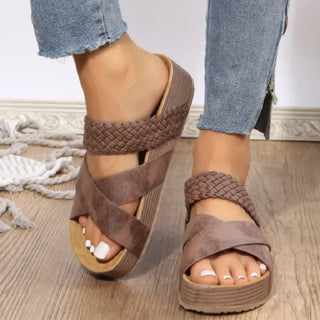 Women's Woven Casual Sandals - Summer Comfort
31,99 €
Women's Woven Casual Sandals - Summer Comfort
31,99 €