Layering Rules: How to Style Your Layered Looks
Layering fails for the same reason almost every time: volume adds up. Three layers that feel fine separately produce a silhouette two sizes larger. The rules below exist for one purpose, stacking without thickening.
Thickness increases outwards
This is the basic rule and the one most often broken, usually by putting a chunky knit under a fitted jacket. The base layer has to be genuinely thin: a cotton vest, a close-knit tee, a fluid shirt. If it already has body, everything above pulls at the armholes.
The test takes three seconds. Put all three layers on and cross your arms as if hugging your own shoulders. If it locks up, the middle layer is too thick or the jacket too tight. A stack that stops you driving or reaching a high shelf will never actually get worn.
Lengths have to be visible
Two layers ending at the same point read as one, and the effort shows nothing. You need at least an inch or two between each hem.
In practice: tee showing below the shirt, shirt showing below the knit, knit stopping above the jacket. The reverse works too, with a long open cardigan over a cropped top. What never works is equal lengths.
Sleeves follow the same logic. A shirt cuff showing half an inch beyond a knit sleeve makes the outfit look built. A shirt sleeve rucked up inside the knit makes it look badly put on.
One texture contrast, no more
Contrast in material is what makes layering interesting: knit against smooth cotton, linen against denim, bouclé wool against poplin. But one contrast is enough. Three strong textures in one outfit fight each other and the eye has nowhere to settle.
The simple marker: one fabric that catches light, one matte, and stop. Knowing how fabrics behave helps you predict it. Viscose slides under a knit; heavy cotton grips it and throws creases across your back.
The neckline, where everything shows
This is the most looked-at part of an outfit and the fastest to get crowded. Two visible necklines is fine. Three and the face disappears.
The V-neck is not compulsory, whatever gets repeated. It opens and lengthens, which helps when layers add bulk at the chest, but a fine crew neck works perfectly under an open shirt. What matters is that only one neckline reads at a time.
Our blouses and shirts often serve as the middle layer: thin enough to sit under a knit, structured enough to wear alone when the temperature climbs.
Colour: stay in one family of values
Layering multiplies coloured surfaces. If every layer heads in its own direction, the silhouette fragments into horizontal blocks and reads shorter.
The method that works: keep two layers close in value and save the contrast for the third. A light beige over an off-white, with a distinctly darker jacket on top. The vertical line survives and the silhouette lengthens.
The test that settles it
Layering only makes sense if you can remove a layer and still be presentable. That is its one practical justification: walk into a heated office, take off the jacket, still have an outfit.
If removing the top layer leaves you in thermal underwear, that was not layering, it was stacking. Before adding a layer, the thirty-second quality test saves you from a knit that pills the first time it rubs against a jacket, which happens fast once you layer. Our best sellers gather the pieces that keep coming back in these combinations.
Free shipping over €35 and 30-day returns, so you can test the full stack at home, arms crossed.
Our models that answer this need


Shop the Best Sellers edit
-
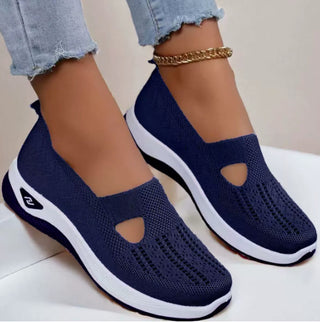 SNEEK Comfort Sneakers for Women — Memory Foam Insole, Breathable Knit
37,99 €
SNEEK Comfort Sneakers for Women — Memory Foam Insole, Breathable Knit
37,99 €
-
 Élise Comfort Sandals — Contoured Footbed, Wide Straps
34,99 €
Élise Comfort Sandals — Contoured Footbed, Wide Straps
34,99 €
-
 Hivery Winter Shoes — Warm Lining, Cushioned Sole
34,90 €
Hivery Winter Shoes — Warm Lining, Cushioned Sole
34,90 €
-
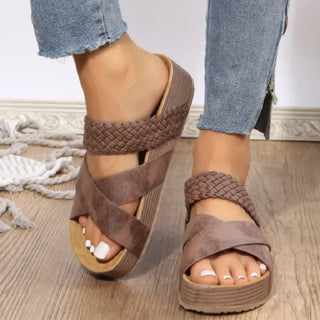 Women's Woven Casual Sandals - Summer Comfort
31,99 €
Women's Woven Casual Sandals - Summer Comfort
31,99 €