

How to Spot a Quality Garment in 30 Seconds
The quality of a garment isn't written on the price tag, and barely on the label. It's written into the construction, and construction can be checked by hand, in the shop, before you pay. Here's what someone who does this for a living looks at, in order.
1. Turn the garment inside out
The first move is always the same: look at the wrong side. That's where everything the maker hoped you wouldn't check is hiding.
A decent seam is straight, even, and tightly stitched — count eight to ten stitches per centimetre. Widely spaced stitches will give. The raw edge should be finished: cleanly overlocked, or better, folded and French-seamed on fine fabrics. An edge already fraying in the shop will fray more with every wash.
Then pull gently on a side seam, without forcing it. If the fabric opens and shows the thread between two stitches, the seam allowance is too narrow: it will split on the first wide movement.
2. Pattern matching at the seams
This is the fastest and most reliable test there is. On a striped or checked garment, look at the side seam and the centre back seam: does the pattern carry on across, or does it jump?
Matching a pattern costs the maker an extra 10 to 15 % in fabric, because the pattern pieces have to be offset to line up. Nobody spends that on a garment built to last one season. A stripe that jumps at the seam is an economic decision, and that decision shows up everywhere else in the garment too.
3. Hang it by the shoulders
Hold it up at eye level and let it hang free. The side seams should fall straight down, perpendicular to the floor.
If they spiral towards the front, the fabric was cut off-grain. The garment looks more or less fine in the fitting room, then twists around the body after two or three washes, and nothing brings it back. It's the sneakiest fault in fast manufacturing, because it's invisible when the garment lies flat.
4. Buttons, buttonholes, fastenings
A properly attached button isn't flat against the fabric: there's a small thread shank underneath, a few millimetres, giving it room to sit in the buttonhole without pulling. Without that shank, the buttonhole gapes as soon as the garment is worn.
The buttonhole itself should be densely stitched all the way round, with no loose threads. A spare button sewn inside is a good sign: the maker expected you to keep the garment.
On fastenings, a metal zip outlasts a nylon one, and on a dress an invisible zip should sit flat, with no ripple or puckering around it.
5. The hem and the lining
Look at how deep the hem is. Three to four centimetres of folded fabric means there's material available to lengthen the garment at a tailor. One centimetre overlocked in a hurry is the industrial minimum: nothing can be let down.
On a light-coloured skirt or pair of trousers, a lining isn't a luxury, it's what stops transparency and underwear lines. It should be sewn, never glued, and left free at the bottom rather than attached to the hem, or the two fabrics pull against each other.
6. The weight in your hand
For the same composition, the heavier fabric is almost always the better one. Weight determines structure, opacity and resistance to pilling. A light, loose knit feels lovely in the shop and bags at the elbow within three weeks.
The companion test takes two seconds: put your hand behind the fabric. If you can clearly see your fingers, the garment will be see-through in sunlight, whatever its colour.
The thirty-second version
If you genuinely have no time: inside out, pattern match, hang by the shoulders, hem depth. Those four checks eliminate most bad purchases and none of them requires any technical knowledge.
Construction is only half the story, though. The rest comes down to the fibre, how it ages and how it washes: our guide to textile fabrics covers how to read a composition label without being fooled. See our blouses · See our best-sellers
To build the look, we have these


Shop the Best Sellers edit
-
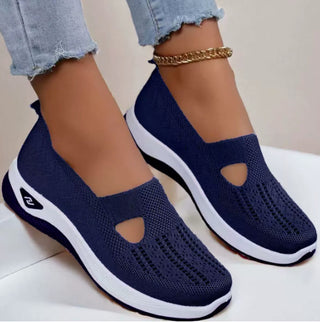 SNEEK Comfort Sneakers for Women — Memory Foam Insole, Breathable Knit
37,99 €
SNEEK Comfort Sneakers for Women — Memory Foam Insole, Breathable Knit
37,99 €
-
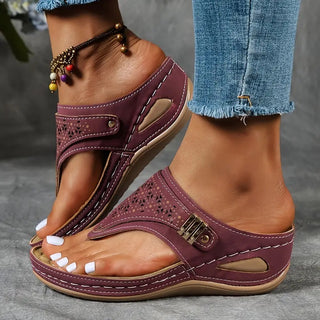 Élise Comfort Sandals — Contoured Footbed, Wide Straps
34,99 €
Élise Comfort Sandals — Contoured Footbed, Wide Straps
34,99 €
-
 Hivery Winter Shoes — Warm Lining, Cushioned Sole
34,90 €
Hivery Winter Shoes — Warm Lining, Cushioned Sole
34,90 €
-
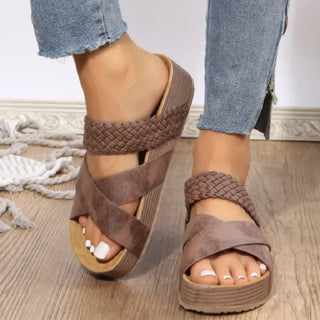 Women's Woven Casual Sandals - Summer Comfort
31,99 €
Women's Woven Casual Sandals - Summer Comfort
31,99 €


