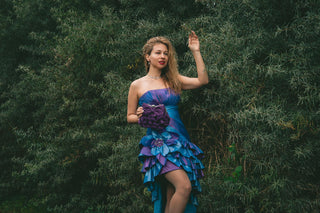
How to Pick a Floor-Length Dress That Truly Suits You
A long dress is the least forgiving garment there is. One piece covers the body from shoulder to ankle, so if a proportion is wrong there's nothing to rescue it. The good news: it all comes down to three variables, and how tall you are isn't one of them.
1. Where the waist sits
This is the decisive point, and it almost always comes second to colour at the moment of buying. A long dress splits the silhouette in two, and it's where that split lands that makes legs look long or short — not your actual height.
An empire cut, with the seam sitting just under the bust, lengthens everything below it: the safest choice under about 1.65 m. A waist marked at the natural narrowest point gives structure and suits anyone with a waist worth showing. A straight cut that falls without marking anything needs a belt or a short jacket, or the silhouette turns into a rectangle.
One common mistake: a waist seam landing on the top of the hips. It shortens the torso and weighs down the bottom half, on every body shape.
2. Length can't be chosen without the shoe
There are only two good lengths. Either the hem stops cleanly above the ankle bone and the dress is worn with flat sandals, or it grazes the floor by a centimetre or two and the dress is worn with the exact shoe you tried it on with.
In between lies the zone that suits nobody: a hem at mid-calf, exactly at the widest part of the leg, which widens it and breaks the line. Two centimetres up or down and the effect reverses.
Hence the rule that saves time: always try a long dress on in the heel height you'll actually wear. A hem that's perfect in heels drags on the ground in flat sandals, and a dragging hem is ruined in three outings.
3. The fabric decides the silhouette
Two dresses of identical cut, in two different fabrics, do not produce the same woman.
Viscose and crepe drape, follow the body without clinging and move as you walk: that's what you want in a fluid summer dress. Cotton poplin and heavy linen hold their volume and stand away from the body, perfect in a loose cut and disastrous in a fitted one, where they form rigid creases. Satin reflects light and underlines absolutely everything: it needs a lining and seamless underwear.
With prints, the scale of the motif matters as much as the motif. A small dense print reads as a solid colour from three metres away; a large one draws the eye to wherever it sits — useful when that's deliberate, annoying when it lands on the bust.
Three things to do in the fitting room
Sit down. A long dress that rides too high when seated, or pulls across the thighs, will only ever work at a standing dinner.
Raise your arms. That's what exposes tight armholes and dresses that lift as one block.
Climb three stairs. A dress that restricts your stride forces you into small steps all day, and it shows.
The bra question
A long dress with thin straps or an open back dictates its own underwear, and that's what most often condemns a beautiful dress to stay in the wardrobe. Solve it before buying, not the night before the event: either the dress has a lined, cupped bodice, or it leaves room for something that works, or it will never be worn.
One dress, several seasons
A plain long dress carries well past summer with no effort: a fine jumper over the top with the dress showing below, a denim jacket, ankle boots instead of sandals, a belt to redefine the waist. It's the best-value piece in a wardrobe, as long as you choose the cut rather than the colour of the season.
See our bohemian dresses · The logical next read: our five essential pieces, of which the long dress is one.


Shop the Best Sellers edit
-
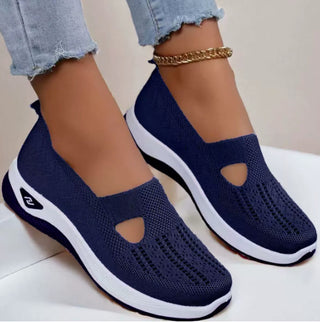 SNEEK Comfort Sneakers for Women — Memory Foam Insole, Breathable Knit
37,99 €
SNEEK Comfort Sneakers for Women — Memory Foam Insole, Breathable Knit
37,99 €
-
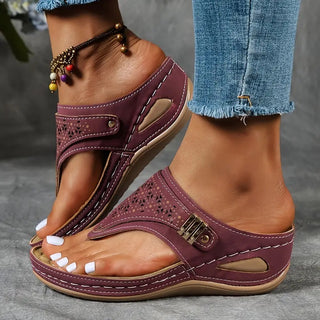 Élise Comfort Sandals — Contoured Footbed, Wide Straps
34,99 €
Élise Comfort Sandals — Contoured Footbed, Wide Straps
34,99 €
-
 Hivery Winter Shoes — Warm Lining, Cushioned Sole
34,90 €
Hivery Winter Shoes — Warm Lining, Cushioned Sole
34,90 €
-
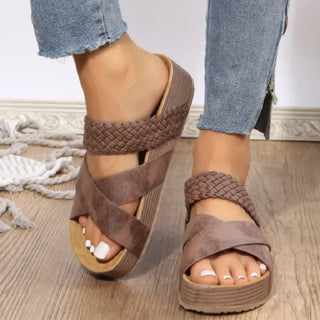 Women's Woven Casual Sandals - Summer Comfort
31,99 €
Women's Woven Casual Sandals - Summer Comfort
31,99 €